English
 September 19, 2026

leave a message
If you are interested in our products and want to know more details,please leave a message here,we will reply you as soon as we can.


Whether an ice machine operates reliably after installation depends heavily on the actual working environment at the site. Ambient temperature, relative humidity, and voltage stability are all factors that must be verified before signing the contract.
This article presents a technical performance analysis of BAOCHARM's 2025 DRC (Democratic Republic of the Congo) BCPY-3.3T-9.9T direct-cooling block ice machine project, examining the relationship between ice-making equipment and tropical operating environments. Whether you are in Africa, Southeast Asia, the Middle East, or the Americas, if your site experiences high ambient temperatures, the performance data and engineering considerations discussed here are directly applicable to your equipment selection process.
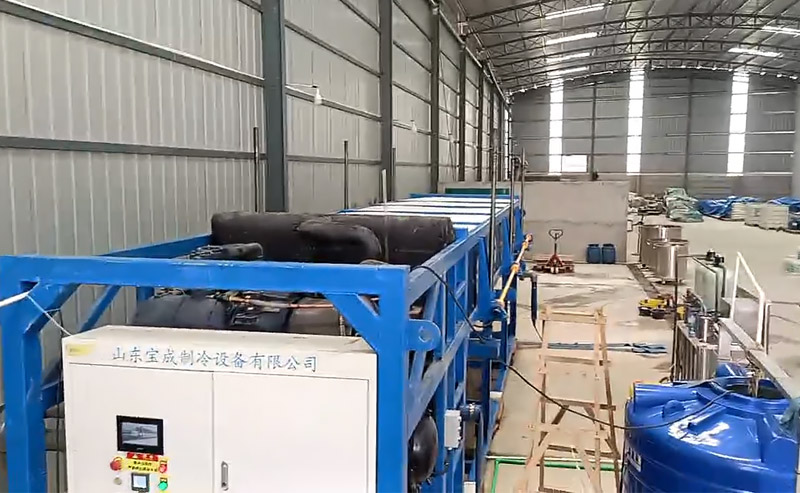
The client operates an ice-selling business in the DRC, supplying fisheries and aquaculture users with block ice for seafood preservation and transport. This was their first industrial ice-making equipment purchase, with no prior operating experience. Before committing to the purchase, the client engaged in multiple discussions with the sales team to evaluate available options.
The central decision was: Traditional saline ice machine or direct-cooling block ice machine?
The sales team provided a detailed technical comparison of both technologies. In addition, they conducted a pre-sale site assessment covering three critical parameters: local climate patterns (temperature and humidity), power grid stability, and available water source quality. This assessment ensured the recommended equipment would be properly specified for the actual installation site.
The client ultimately selected the BCPY-3.3T-9.9T direct-cooling block ice machine. Key specifications include:
Following standard shipping and on-site installation, the equipment commenced operation. Post-installation inspection confirmed zero service calls within the first 60 operating days. Actual yield met 100% of the 10-ton/day nameplate capacity, and all performance metrics matched the pre-delivery checklist with no deviations.
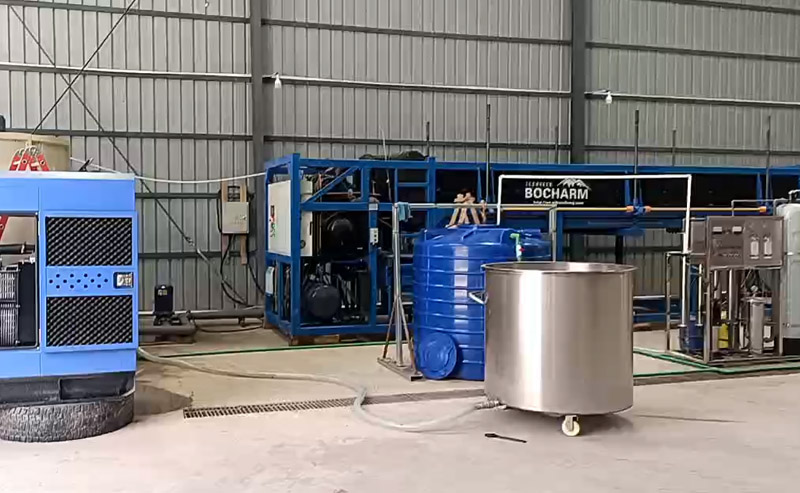
The DRC is predominantly within an equatorial climate zone, characterized by year-round high temperatures. Key climate data:
These conditions impose specific engineering requirements on a direct-cooling block ice machine:
These climate factors are not unique to the DRC. Comparable conditions exist across Southeast Asia (Malaysia, Philippine), the Middle East (Saudi Arabia, UAE), and the Americas (Mexico, Brazil). Regardless of your specific location, these parameters should guide equipment selection for any tropical installation.
Compared to traditional saline-type ice machines, the direct-cooling block ice machine offers measurable performance advantages in tropical environments:
The direct-cooling block ice machine uses refrigerant to exchange heat directly with water inside the evaporator plate, eliminating the intermediate saline loop and the associated energy transfer losses. The BCPY-3.3T-9.9T is equipped with an energy-efficient screw compressor, delivering approximately 20% lower energy consumption per ton of ice produced compared to saline-type systems of equivalent capacity.
Quantified impact: Based on a 20% reduction in energy consumption (approximately 12 kWh/ton saved at typical tropical operating conditions), the payback period for the direct-cooling system is estimated at 18 months versus 30 months for a saline system of comparable capacity, assuming average commercial electricity rates.
The BCPY-3.3T-9.9T achieves a 6-hour freezing cycle and can complete up to 4 cycles per 24-hour period. Traditional saline systems typically require 12+ hours per freezing cycle under similar ambient conditions.
Quantified impact: With the same equipment investment, the direct-cooling system produces approximately twice the daily output of a saline system (10 tons vs. 5 tons from an equivalent saline setup). This translates to faster inventory turnover and more responsive supply to fisheries customers.
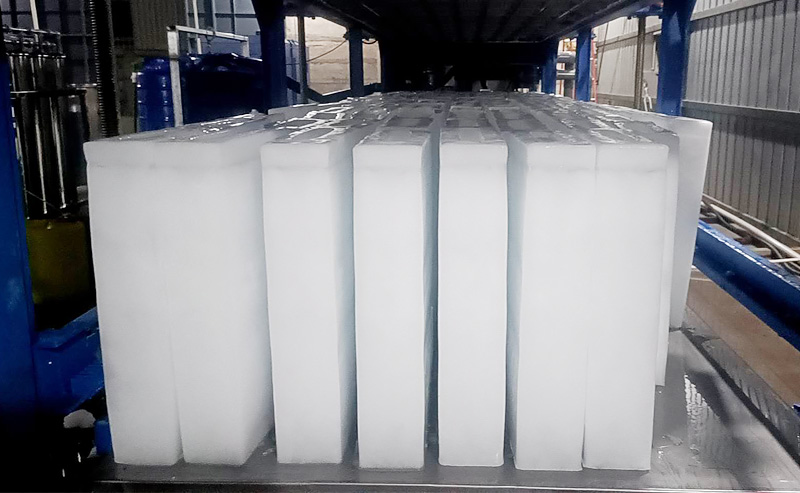
The direct-cooling block ice machine eliminates the need for a saline immersion bath. As long as the feed water meets local potable standards, the ice is suitable for direct food contact—a critical requirement for fishery and aquaculture ice applications where ice comes into direct contact with seafood products.
Quantified impact: No saline residue on block surfaces means no post-production washing required. End-users receive ice that meets international food safety standards for direct seafood contact, reducing rejection rates and improving supply chain reliability.
The BCPY-3.3T-9.9T features a modular skid design with a PLC-based automatic control system. The system manages water filling, freezing, and de-icing sequences without manual intervention. One operator can manage the entire production process.
Quantified impact: The modular skid design reduces on-site installation time to approximately 8 man-hours and requires only standard 20-foot container logistics, avoiding the need for specialized heavy-lift equipment. The automated control system eliminates the need for trained operators to manage freezing cycles, a significant advantage in regions with limited technical labor availability.
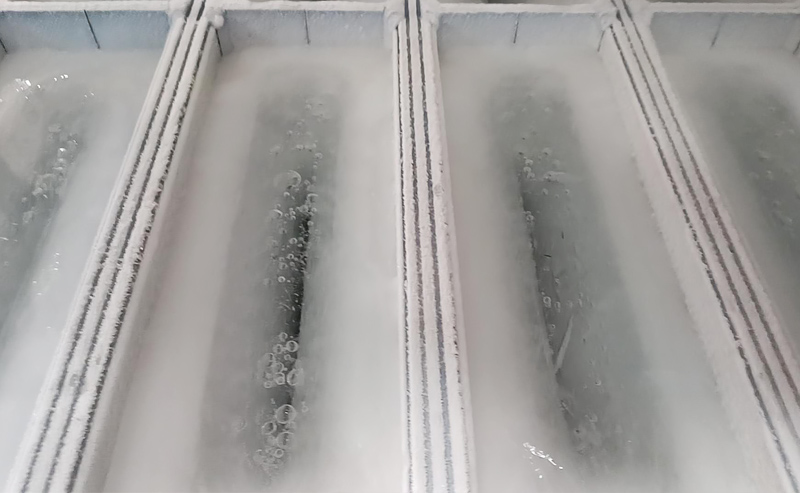
Returning to the DRC case study, the successful adaptation of the BCPY-3.3T-9.9T to local conditions is supported by specific engineering choices:
Compressor Specification: The unit is equipped with a screw compressor developed through an ODM partnership with Shanghai Hanbell, specifically engineered for ice-making applications. The compressor maintains its rated cooling capacity at condensing temperatures up to 50°C, ensuring consistent 6-hour freezing cycles even during peak ambient conditions. At 45°C ambient temperature, the compressor delivers sufficient cooling capacity to maintain full rated ice production without performance derating.
Condenser Configuration: The unit employs an evaporative condenser that combines water spray and forced-air circulation. This design achieves a heat transfer coefficient approximately 1.2 times higher than air-cooled condensers of equivalent surface area, making it particularly suitable for sites with limited water availability or poor water quality. The evaporative system maintains full rated performance at 50°C ambient dry-bulb temperature.
Material Specification: The evaporator plate and structural frame utilize SUS304 stainless steel in contact areas, combined with hot-dip galvanized coatings on non-contact structural members. This material combination provides corrosion resistance suitable for coastal high-humidity environments and continuous operation in condensing conditions.
Electrical Protection: The control panel features IP65-rated enclosure sealing, with conformal coating applied to circuit boards to prevent moisture-related failures. The system includes undervoltage and overvoltage protection (±10% of rated voltage), accommodating typical grid fluctuations in developing markets.
Installation Requirements: Pre-delivery site verification confirmed:
All requirements were met, enabling one-time, problem-free installation.
| Parameter | Specification |
| Model | BCPY-3.3T-9.9T |
| Daily production capacity | 10 tons (24 hours) |
| Ice block specification | 25 kg / 405 blocks per day |
| Installed power | 50 KW |
| Voltage / Frequency | 380V / 50Hz (customizable) |
| Refrigerant | R507A / R404A (optional) |
| Ambient temp. range | -30°C to +50°C |
| Control system | PLC with touchscreen |
If you are evaluating an ice-selling business investment in tropical regions—whether in Africa, Southeast Asia, the Middle East, or the Americas—these three recommendations are based on field performance data from this and similar installations:
Each of these factors affects equipment performance and must be addressed in the technical specification before shipment.
Q1: What is the maximum ambient temperature for reliable operation of the BCPY-3.3T-9.9T?
A: The equipment is rated for continuous operation at ambient temperatures up to 50°C, as specified in the product technical data sheet. The evaporative condenser and screw compressor combination maintains rated cooling capacity at this temperature. For sites exceeding 50°C, consult the engineering team for potential modifications.
Q2: What is the actual energy consumption per ton of ice produced?
A: Under typical tropical operating conditions (30-40°C ambient), the BCPY-3.3T-9.9T consumes approximately 60-65 kWh per ton of ice produced, compared to approximately 80 kWh/ton for saline-type systems. Actual consumption varies based on ambient temperature, water inlet temperature, and condenser maintenance status.
Q3: Can the equipment be adapted for different grid voltages?
A: Yes. The equipment supports custom voltage configurations. The DRC standard (380V/50Hz) matches the standard Chinese specification. For other countries, configuration options include 220V/60Hz, 415V/50Hz, or other local standards. The installed power requirement is 50KW at full load; site electrical infrastructure must be sized accordingly.
Q4: What are the recommended maintenance intervals for tropical operation?
A: Based on DRC site experience and manufacturer recommendations: condenser coil cleaning every 1,000 operating hours (or monthly in dusty/humid conditions); compressor oil and filter change at 5,000 operating hours; and electrical connection torque checks every 6 months. The automated control system provides maintenance alerts through the PLC display.
Q5: What is the typical payback period for this equipment?
A: Based on the energy savings of approximately 12 kWh/ton and the labor reduction from automated operation, the incremental cost of the direct-cooling system compared to a saline system of equivalent capacity is typically recovered within 18 months at commercial electricity rates. After payback, the lower operating costs directly increase net profit margin.
From Africa's interior to the coastlines of Southeast Asia, from the Arabian Peninsula to the Americas—equipment has been installed and validated across diverse climate zones since the company's founding in 2012.
As a drafting unit of the industry standard for "Direct-Cooling Block Ice Machines" (JB/T 14567-2022) , BAOCHARM holds 40+ patents in ice-making technology. Product applications include aquatic product preservation, fruit and vegetable fresh-keeping, industrial process cooling, and cold chain logistics—all sectors requiring reliable ice production under varying environmental conditions.
Equipment is certified to international standards including CE, UL, and ISO 9001, ensuring compliance with safety and quality requirements across major global markets.
Wherever your site is located, a technically specified solution matched to your local operating parameters can be provided, backed by reference installations in comparable climate conditions.
The technical team offers free pre-installation site assessment and customized equipment selection for your specific operating conditions.Contact the sales team directly for reference cases in your region.
BCPY-3.3T-9.9T – 10-ton direct-cooling block ice machine, rated for ambient temperatures up to 50°C.


Our Contacts
Email: sales@baocharm.com
WhatsApp: +86 17663537579
Wechat: +86 17663537579
Working Hours: Mon ~ Sat 8:30 AM - 5:30 PM
 IPv6 network supported