English
 September 19, 2026

leave a message
If you are interested in our products and want to know more details,please leave a message here,we will reply you as soon as we can.


Flake ice and block ice are not competing versions of the same product. Flake ice is built for speed — thin, high-surface-area flakes that wrap around product and release cooling within minutes. Block ice is built for duration — dense, slow-melting blocks that hold cold over hours or days with minimal handling. The selection question is not which is better, but which cooling logic matches the process. Some operations use both: flake ice for pre-chilling, block ice for holding.
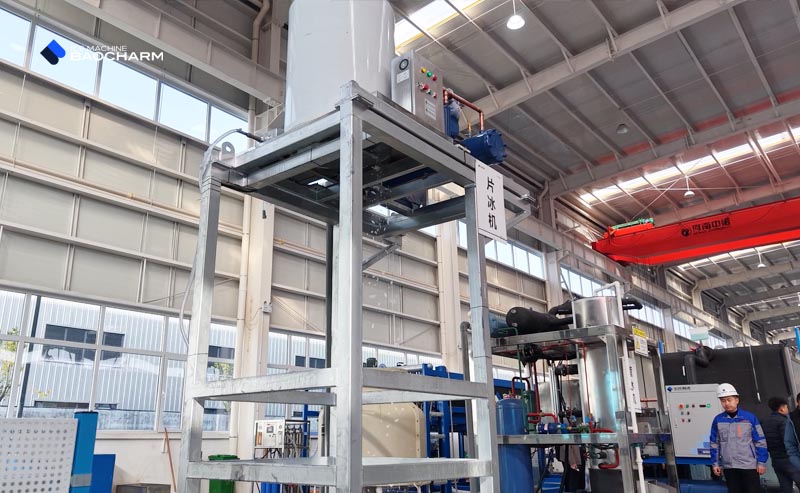
Flake ice is produced as thin, sub-cooled flakes with a thickness typically around 1.5–2.2 mm. That geometry gives it a very high surface area per ton. When flake ice contacts a product, it melts quickly and absorbs latent heat at the interface. The cooling response is fast, and the ice conforms to irregular surfaces rather than sitting as a solid mass.
Block ice has a low surface-area-to-volume ratio by design. It melts more slowly than flake, crushed or tube ice, which is precisely why it is specified for cooling duration rather than rapid heat exchange. A block holds cold for an extended period with minimal melt loss, and it can be stored and transported without the handling attention that flake ice requires.
Both, in sequence: seafood processing is a common example. Flake ice is used at landing to drop core temperature quickly; block ice or a cold-storage system holds the chilled product for later transport.
| Factor | Flake ice | Block ice |
| Cooling speed | Fast; high surface area drives rapid heat transfer | Slow; low surface-area-to-volume ratio |
| Cold retention | Shorter; melts more readily | Longer; dense mass holds cold over time |
| Surface contact | Wraps around product; enters gaps between items | Point contact; sits as a solid mass |
| Handling and automation | Conveyable, meterable, suited to automated delivery | Requires lifting and placement; less suited to automated dosing |
| Typical applications | Pre-chilling, concrete, reactor cooling, food processing | Storage, transport, long-duration holding |
| Storage requirement | Insulated bin with delivery system | Cold store or hold; minimal melt loss |
Comparison describes cooling behaviour and handling characteristics, not a ranking of ice types. Selection depends on process holding time and handling requirements.
The ice-type decision should be made before capacity is discussed. A buyer who compares flake and block ice on tons per day is comparing the wrong variable: the same tonnage delivers very different cooling outcomes depending on melt rate and surface contact.
If the process requires temperature to drop quickly, flake ice is the candidate. If the process requires cold to be held without re-icing, block ice is the candidate. If both are required, the system design should include both ice types or a flake ice system with sufficient cold storage to bridge the holding period.
The direct-cooling transparent block ice machine is a separate product category with its own selection logic. The comparison here is at the ice-type level, not a product-versus-product comparison.
How do flake ice and block ice differ for industrial cooling?
Flake ice is thin and high-surface-area, so it melts quickly and removes heat rapidly. Block ice is dense and slow-melting, so it holds cold for longer. The difference is cooling speed versus cooling duration, not a difference in quality.
When should I choose flake ice vs block ice?
Choose flake ice when the process needs rapid temperature reduction, product contact or automated ice delivery. Choose block ice when the priority is long-duration cold retention with minimal handling. If the process has both a pre-chilling step and a holding step, consider both ice types or a flake system with cold storage.
What is direct-cooling block ice used for?
Direct-cooling block ice is a dense, slow-melting ice format suited to storage and transport where cold must be held over an extended period. It is not a substitute for flake ice in rapid pre-chilling or process cooling; the two serve different stages of the cooling chain.
Compare flake and block ice against your holding time and handling needs. Request an ice-type decision matrix built around your actual duty. → Compare ice types


Our Contacts
Email: sales@baocharm.com
WhatsApp: +86 17663537579
Wechat: +86 17663537579
Working Hours: Mon ~ Sat 8:30 AM - 5:30 PM
 IPv6 network supported